When Smart Leaders Say the Wrong Things: Closing the Executive Communication Divide
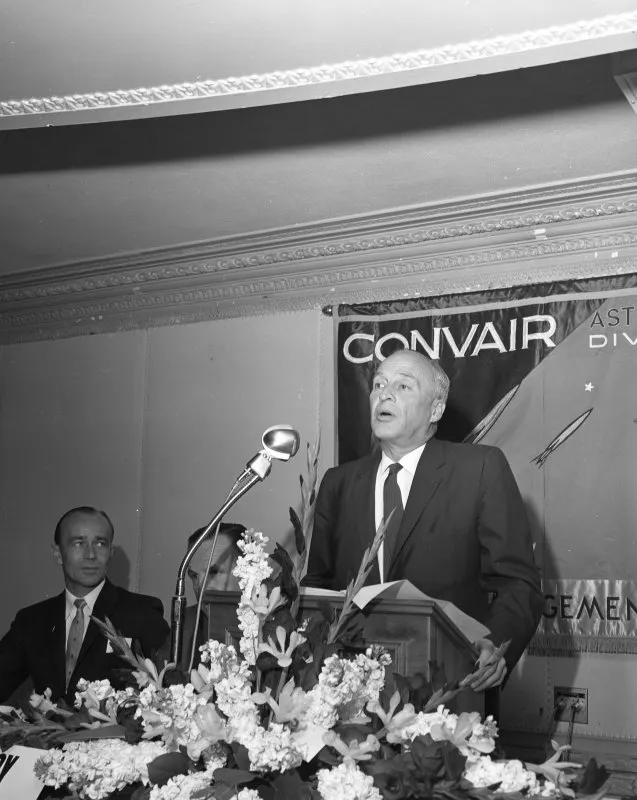
Photo: San Diego Air & Space Museum Archives, Public domain, via Wikimedia Commons
High-performing executives routinely rise to the top on the strength of their technical acumen, strategic thinking, and results-driven mindsets—yet many stumble the moment they step in front of their own teams. The gap between knowing and communicating is not a flaw of intelligence; it is a failure of translation. Understanding why this divide exists—and how to close it—may be the most consequential leadership investment an organization can make.
The Paradox at the Top
There is a persistent myth in American corporate culture that leaders who reach the C-suite have, by definition, mastered every dimension of professional effectiveness. The corner office, after all, signals arrival. Yet communication coaches, organizational psychologists, and executive consultants will tell you the same thing with remarkable consistency: the higher a person climbs, the fewer honest signals they receive about how their words actually land.
This is not simply a matter of stage fright or poor public speaking habits. The communication gap that plagues many senior leaders is structural. It is built into the very environment that produced their success. When feedback loops collapse—when direct reports hesitate to push back and peers default to deference—executives begin speaking into an echo chamber without realizing the chamber exists.
The result? Town halls that feel scripted. All-hands meetings that generate more confusion than clarity. Carefully worded memos that employees read once, then disregard. And beneath all of it, a slow erosion of trust that shows up in engagement surveys, exit interviews, and ultimately, in turnover numbers.
The Jargon Trap
One of the most common—and most underestimated—communication failures among senior leaders is the overuse of corporate language. Terms like synergy, bandwidth, move the needle, and circle back have become so embedded in executive vocabulary that many leaders deploy them reflexively, without considering whether they actually communicate anything meaningful.
The danger is not that employees find this language annoying, though many do. The real danger is that jargon creates distance. It signals, whether intentionally or not, that the speaker is operating in a different world than the listener. When a frontline employee hears an executive talk about "leveraging cross-functional alignment to drive enterprise value," what they often hear is: You are not the audience I am really speaking to.
Authentic communication requires a willingness to trade precision of terminology for clarity of meaning. That is a harder discipline than it sounds, particularly for leaders whose professional identities are deeply tied to mastery of technical language. But the shift is essential. The most effective executive communicators are those who can take a complex strategic reality and render it in terms that a skeptical, time-pressed, emotionally intelligent workforce can immediately understand and act upon.
Disconnection Is a Leadership Risk
Beyond language, there is a deeper issue: many executives communicate about what matters to them rather than what matters to their audience. A quarterly earnings update delivered to employees with the same framing used for Wall Street analysts is not a communication strategy—it is a repurposed investor relations deck.
Employees are asking fundamentally different questions than shareholders. They want to know: Is my job secure? Does leadership see the challenges I face every day? Does what I do here actually matter? When executive communication fails to address those underlying concerns—even implicitly—employees disengage. And disengagement, as Gallup has documented extensively across American workplaces, carries a staggering organizational cost.
Leaders who bridge this divide do so by practicing what might be called audience-first thinking. Before crafting any message, they ask: What does this person need to feel, know, and do after hearing this? That sequence—feel, know, do—is not accidental. Emotion precedes cognition in human decision-making, and leaders who understand this sequence communicate with far greater impact.
The Vulnerability Question
Perhaps the most uncomfortable dimension of executive communication is vulnerability. Many leaders—particularly those who came of age in command-and-control organizational cultures—were explicitly taught that admitting uncertainty signals weakness. Showing doubt, they were told, undermines authority.
The research tells a different story. Studies in organizational behavior consistently find that leaders who acknowledge mistakes, express genuine uncertainty, and share the human dimensions of their own professional journey are perceived as more credible, not less. Vulnerability, deployed thoughtfully, is not the opposite of authority. It is the foundation of trust.
This does not mean executives should unload personal struggles on their teams or perform emotional transparency as a management technique. Authentic vulnerability is purposeful. It says: I do not have all the answers, and I respect you enough to tell you that. In an era when younger workers—Millennials and Gen Z employees who now constitute the majority of the American workforce—actively seek leaders they can believe in rather than simply comply with, this kind of honest communication is no longer optional. It is a competitive advantage.
Communication as a Learnable Discipline
The most important reframe any executive can make is this: communication is not a personality trait. It is a skill. And like every other professional skill, it can be studied, practiced, and improved.
The leaders who communicate most powerfully did not simply wake up one day with the ability to move a room. They invested in understanding their audiences. They sought honest feedback, often from sources outside their immediate organizational hierarchy. They practiced—in keynote settings, in small group conversations, in one-on-one exchanges with people at every level of the organization. And they remained genuinely curious about whether their words were producing the outcomes they intended.
For organizations serious about culture, retention, and sustainable performance, the communication capability of senior leadership is not a soft consideration. It is a strategic priority. When executives speak in ways that resonate—that inform, inspire, and connect—the effects ripple through every layer of the organization. When they do not, the silence that follows is expensive.
Closing the leadership communication gap begins with the willingness to be honest about its existence. That, as it turns out, is the first act of authentic leadership.